Categories
Maki Recipes

To My Bloggers…

[HDR-IMG]

Not long ago I was, quite frankly, an internet noob. Sure, I’ve used the internet for email and instant messaging since the ’90s, but aside from researching for school papers, my internet use rarely went beyond that. Of course I was on MySpace and Facebook in high school and college – everyone was on such social networking sites, and that was often the best way to stay in touch with my friends after we graduated.

Little did I know, there was an entire world I was unaware of.

On November 1st, 2006, I entered the world of blogging. Up until then, I had never subscribed to or commented on a blog – I didn’t even know what an RSS feed was. The internet was a scary place – who knew what sort of people were behind the avitars and screennames… for all I knew, these were weirdos trying to decieve us all into thinking they were really the people they pretended to be online.

Little by little, I learned that this was rarely the case. Ralph Whitbeck and Yvo were two commenters who have been with Sushi Day from the beginning. They started as complete strangers, but slowly I have gotten to know the real people behind the blogs.

This was just the start to a wonderful community of real people I have gotten to know over the internet. There are some I’ve been lucky enough to meet in person, and so many more I hope to be lucky enough to meet someday.

However, the food blogging world was just the start. Although vast and full of amazing people, some of my closest online friends have come from blogs completely unrelated to the food blogging world. There are so many fantastic bloggers I want to tell you about, but for now I’ll limit myself to introducing you to Karen Swim. One of the strongest women I know, she writes inspirational posts that help you live your life to it’s fullest, and always make you think.

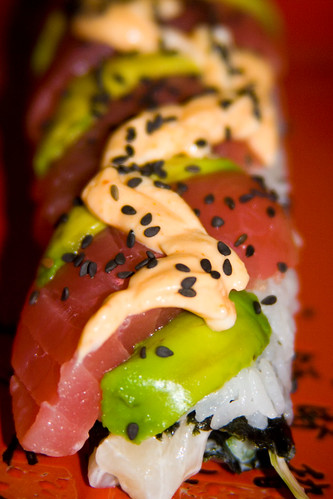
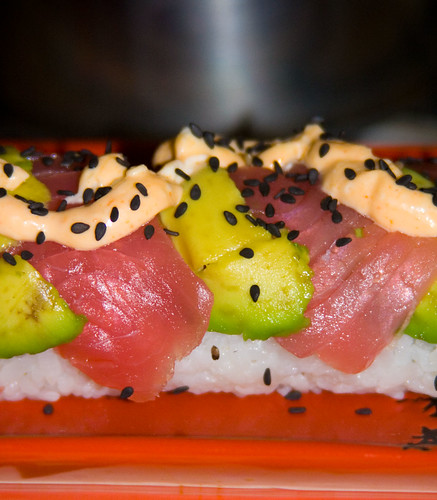
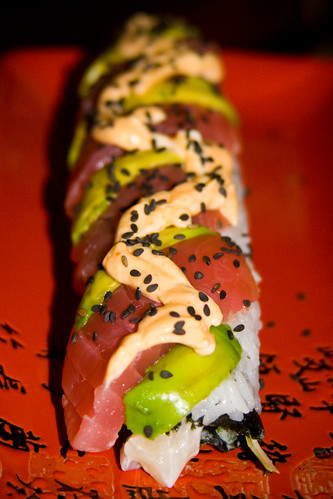
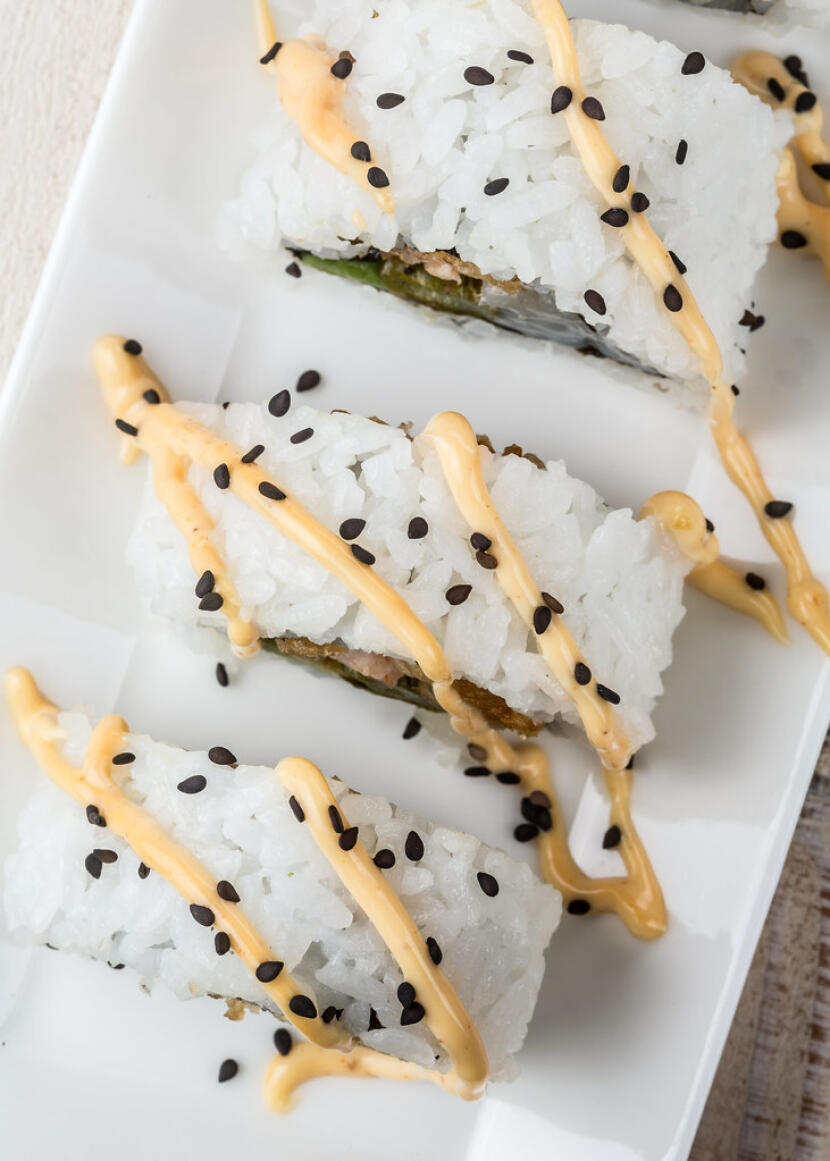
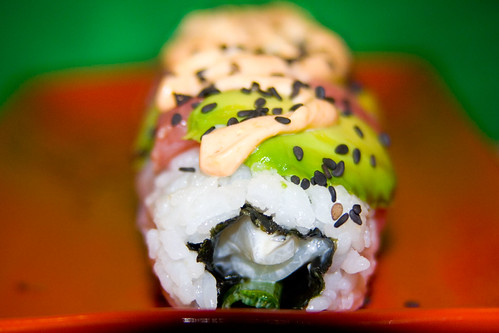
Not to long ago, she was lucky enough to work with Harry and James from Men with Pens, who made her a beautiful new design for her website. You really should go check it out… it’s incredibly elegant, and suits her perfectly. In celebration, I promised her I’d make a new roll, just for her. (Because really, what’s more awesome than having your own roll, made just for you? πŸ˜€ ) I used all my favorite ingredients – green onion, scallops, tuna, avocado, tempura shrimp, and spicy mayonnaise – and combined it all to make one of the prettiest rolls I have ever made. The ingredients all meld together to create a delicious explosion of sashimi flavors in your mouth, accented perfectly by the avocado, green onion, and spicy mayonnaise. Truly amazing – enjoy!

Ingredients
  • 6 sheets nori
  • 3 cups sumeshi
  • 6 stalks green onion
  • 12 pieces tempura shrimp
  • 6 sashimi-grade scallops
  • 1 medium avocado
  • 6 oz sashimi-grade tuna
  • 1 cup mayonnaise
  • 1 tsbp Sriracha sauce
  • 1 oz toasted black sesame seeds
Cooking Directions
  1. Cook sushi rice.
  2. Bake tempura shrimp for 12 minutes at 375 degrees Fahrenheit
  3. Cut the tails off the tempura shrimp.
  4. Cut the avocado in half, discarding the pit.
  5. Use a large spoon to scoop the avocado out of the hard skin, being careful to keep the avocado half as whole as possible.
  6. Slice the avocado into slices.
  7. Wash the green onion, cut the long green stalks off of the white bulbs. Discard the white bulbs.
  8. Slice the scallops into several pieces, about a centemeter square.
  9. Mix with 2 tbsp mayonnaise.
  10. Slice the tuna into thin pieces, about the same width as the avocado slices.
  11. Mix the rest of the mayonnaise with the Sriracha sauce.
  12. Roll the sushi inside-out, using a stalk of green onion, 2 pieces of tempura shrimp, and one scallop worth of chopped scallop as your fillings, but don’t cut the roll quite yet.
  13. Lay alternating strips of avocado and tuna diagonally over the roll, overlapping slightly.
  14. Using the plastic wrap-covered rolling mat, press the tuna and avocado tightly into the roll.
  15. Cut one tip off of a ziplock bag.
  16. Fill the bag with the spicy mayonnaise.
  17. Squeeze the spicy mayonnaise over the roll.
  18. Sprinkle black sesame seeds on the top of the roll.
  19. Slice the roll into six or eight pieces.
  20. Enjoy!

Serving Size: 1 roll Karen Swim’s Roll

  • Calories: 485
  • Fat: 25g, 38% DV
  • Saturated Fat: 3g, 15% DV
  • Cholesterol: 51mg, 17% DV
  • Sodium: 790mg, 33% DV
  • Total Carbohydrates: 46g, 15% DV
  • Dietary Fiber: 4g, 16% DV
  • Sugars: 17g
  • Protein: 19g, 37% DV
  • Vitamin A: 29%
  • Vitamin C: 20%
  • Calcium: 7%
  • Iron: 14%
  • Magnesium: 13%
  • Potassium: 10%

Percent Daily Values are based on a 2000 calorie diet. These values are only estimates based on the individual ingredients, and not meant to replace the advice of a medical professional.

More Pictures
Categories
Maki Recipes

Santa Barbara Roll

Many things can happen in a year. A year ago, I was in Santa Barbara for my cousin’s wedding – one of the most beautiful weddings I have ever been to (and I’ve been to quite a few!) That was one of the only times I had ever been to Santa Barbara.

A year ago, my brother relapsed. He has been undergoing treatment for the past year, and should be cancer-free a year from now.

A year ago, I was beginning my last year of college. To not have to worry about scheduling classes, buying books, going to lectures, and taking tests – it’s a wonderful feeling to have graduated.

A year ago, I had never tried sashimi. Now, a year later, I use sashimi in nearly every recipe I make. I’ve got to make up for all those years without sashimi, right?

A year ago, Son and I were designing the Sushi Day shirts, hoping and praying that people would actually buy them. A year later, we’ve sold many of the shirts, and we still have a few left, if you’d like to buy one!

Santa Barbara Roll

What has happened for you in the past year? What are you looking forward to in the next year?

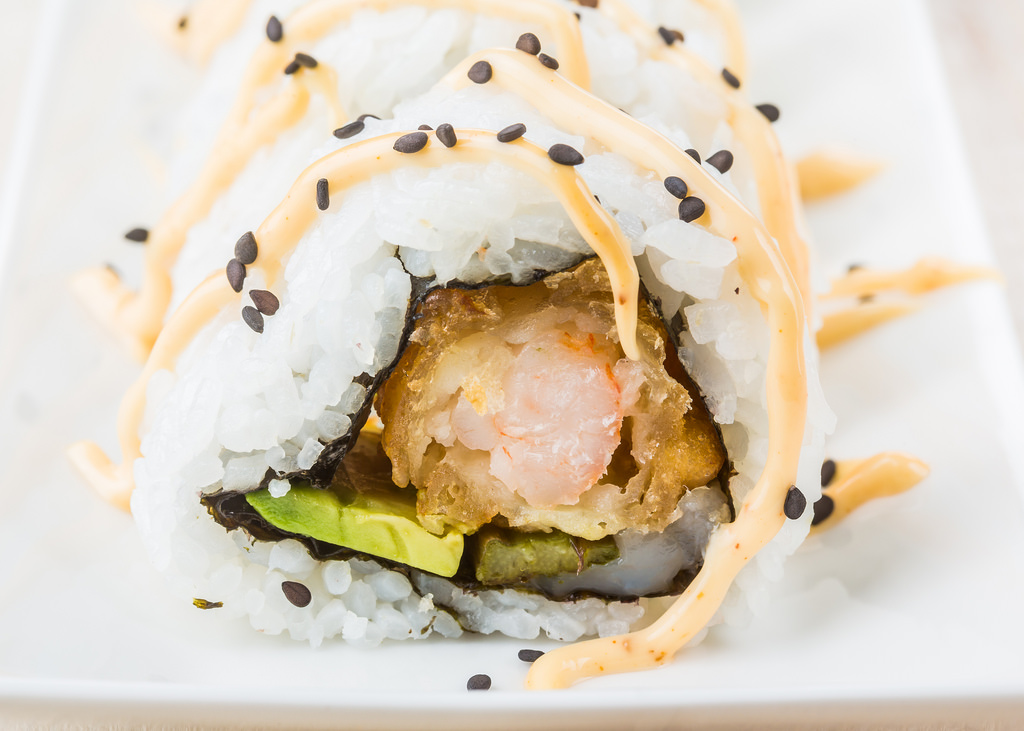
If nothing else, your next year should definitely include these Santa Barbara Rolls. All the ingredients come together to make a delicious piece of sushi, and yet the hotate (scallop) still manages to shine through. I couldn’t stop eating them… even now, I’m craving more!

Ingredients
  • 6 sheets nori
  • 3 cups sumeshi
  • 12 tempura shrimp
  • 1/2 small avocado
  • 6 stalks asparagus
  • 6 sashimi-grade scallops
  • 1 cup mayonnaise
  • 1 tbsp Sriracha sauce
Cooking Directions
  1. Cook sushi rice.
  2. Bake the tempura shrimp according to the directions on the package, or make your own. (I usually bake them for 10 min at 350 degrees.)
  3. Remove the tails of the shrimp.
  4. Cut the avocado in half, discarding the pit.
  5. Cut off the hard skin and discard.
  6. Slice the avocado into thin sticks.
  7. Steam asparagus for a couple of minutes until they are easy to bite into.
  8. Remove the tough section of the scallops and discard, or freeze to use in a seafood stock later.
  9. Slice the scallops into about 4-6 slices, depending on the size of the scallops.
  10. Mix the mayonnaise and Sriracha sauce.
  11. Roll the sushi inside-out, using two pieces of tempura shrimp, some avocado, a stalk of asparagus, and the equivalent of one scallop as your fillings.
  12. Spoon the spicy mayonnaise into a plastic ziplock bag and cut a tiny bit of one of the bottom corners of the bag off.
  13. Squeeze the spicy mayonnaise through the hole to drizzle over your sushi.

Categories
Other Recipes

Hotate Special, and More Randomness

I’ve gotten tagged with another “random things” meme, this time by Nicole from For the Love of Food. Of course, if you don’t want to know more randomness about me, you can always skip to the yummy Hotate Special recipes and pictures at the end of this post. πŸ˜€

  1. Up until nine months ago, I had never tried sashimi. My mother is allergic to fish, so it was rare that we ate fish at our house. Of course, now that I’ve tried sashimi, it’s pretty obvious I’m in love (as can be seen in all the sushi I make with sashimi these days!)
  2. I performed in the Nutcracker ballet for eight consecutive years. I’ve danced nearly every role… from a little boy in the party scene (we had a huge shortage of boys, so the smaller girls always played the boy parts before getting to be a girl in the party scene), to a Spanish (chocolate) dancer, to the Arabian (coffee) pas de deux, to Dew Drop Fairy. Fourteen roles in all. My favorite of all was easily the Arabian pas de deux… it’s a sensual dance with several amazing lifts, and lifts were always my favorite part of a pas de deux.
  3. In eighth grade, I came in first place for the Reach for the Stars (astronomy) event at our regional Science Olympiad. At the time I was really passionate about astronomy… my dad had has a pretty nice telescope, and at the time I knew just about every constellation in the sky.
  4. I’m half Japanese, a quarter Swedish, and one eighth Irish. The other eighth is comprised of German, English, and other European randomness. Unfortunately, I speak very little Japanese, and even less Swedish or Irish. (I’ve got English down though! πŸ˜› ) I figure I’ll start with Japanese, then try to learn Vietnamese (since it would be *really* nice to be able to understand Son’s family all the time) and then move on to the other languages.

*******

And now, for the sushi.

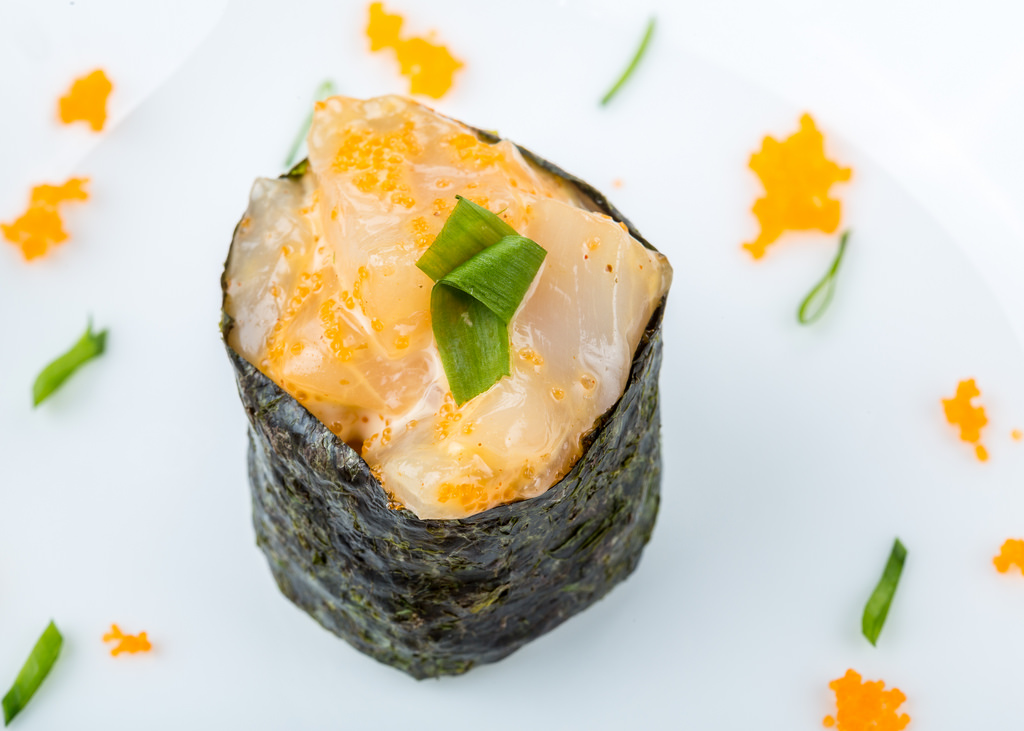
The Hotate (scallop) Special is a type of sushi I first had about a month or so ago, when I went up to Sunnyvale with Son on a business trip. We went to a sushi restaurant called Seto Japanese cuisine, where Son and I decided we wanted to try something new. As I wrote in my review of the restaurant, I loved the Hotate Special so much, that I just had to try to replicate it at home.

Have I mentioned scallops are my new favorite sashimi? They’re so soft and delicious, it’s hard not to like them. One thing though… when you get the scallops, there’s a little piece on the side of them, as if you had rolled a ball of dough and then stuck another piece of dough to the side of it. Personally, I prefer to discard this piece. I find that it is tough and chewy, not at all like the rest of the scallop. Luckily, it’s only a very small piece, so I don’t feel as if I’m wasting too much of it.

Ingredients
  • 1 sheet nori
  • 1 cup sumeshi
  • 4 sashimi-grade scallops
  • 1 tbsp mayonnaise
  • 1 tsp tobiko
Cooking Directions
  1. Cook sushi rice.
  2. Chop the scallops into 1/2 inch pieces.
  3. Mix the chopped scallops, mayonnaise, and tobiko.
  4. Prepare the sushi gunkan-style, except replace the ikura with 1/4 of the scallop mixture.
  5. Repeat to make four pieces.

Categories
Recipes

Deviled Eggs

Deviled eggs are a tradition for my family. Nearly as much as spinach dip, deviled eggs find their way to every family function I go to. Up until just over three years ago, I had never met someone who had never heard of deviled eggs.

That all changed when Son and I started dating. He had grown up in Vietnam, so many of the foods that we assume to be common in the United States were unfamiliar to him. His first encounter with deviled eggs was on the Fourth of July in 2005. We had invited him to join our family barbecue, and set off fireworks afterward. (In our city, it is legal to set off fireworks.) We had our usual barbecue fare – spinach dip, beef teriyaki, hamburgers, potato salad… and deviled eggs.

One bite and Son was in love. (Should I be jealous? Maybe…) In fact, he adores deviled eggs so much that my mom will sometimes make deviled eggs just for him. (Every woman likes a man who loves her cooking.) Every time we have them at a party, he’s the first person we tell.

And what’s not to love? (Ignoring the lack of health benefits, of course.) Deviled eggs are perfectly-sized, creamy, and slightly salty finger food – the perfect party appetizer. I haven’t yet found a person who doesn’t love them, and it’s a recipe that is very easy to scale up to feed many. Sure, they may be slightly high in fat and cholesterol, but who goes to a party expecting to eat healthy food? I certainly don’t.

I think you’ll love this recipe that my mom uses from a cookbook called “Picnics & Tailgate Parties”.

Deviled Eggs

Makes 12 deviled eggs

Ingredients
  • 6 hard boiled eggs
  • 3 tbsp mayonnaise
  • 1 tsp dijon mustard
  • salt and pepper
Cooking Directions
  1. Peel the eggs.
  2. Slice each egg in half lengthwise.
  3. Carefully remove egg yolks into a bowl; set egg whites aside.
  4. Mash egg yolks with mayonnaise, dijon mustard, and salt and pepper.
  5. Evenly fill egg whites with yolk mixture.
  6. Refrigerate until ready to eat.
Categories
Other Sushi Randomness

Koo-Ki Sushi

[HDR-IMG]

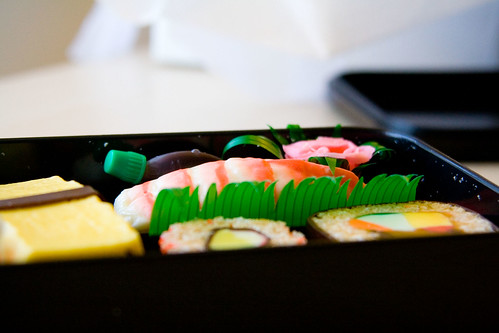
When you get deep into the sushi world, something that begins to come up is candy sushi. Often, people use Hostess Twinkies or Rice Crispy Treats as the sumeshi, with Fruit Roll-Ups for the nori. However, many have heard of Suedy’s Koo-Ki Sushi. These also use a rice crispy base, but use various types of chocolate, caramel, and gummy candies for their nori and sushi fillings. Often I have lusted over the delicious-sounding descriptions and beautiful pictures on their website, but I never believed I would actually try their candy sushi. At prices from $10 for a pair of chocolate chopsticks, to $65 for an entire bento box of candy sushi, the prices have always been a bit out of my range.

A couple of weeks ago, my mom called me. “You have a package coming tomorrow, will you be home?” I assured her I would be, curious about this unexpected package. “You’re going to love it,” she promised.

The next day, a delivery man came to my door with a light package. While I was signing for the box, he glanced at the return address, then looked at me with question in his eyes. “Sushi?” I smiled and nodded, not entirely sure what he was talking about. When I turned back into my apartment and took a look at the return address, my face lit up like a kid who just found out she gets to go to Disneyland. The name on the return address: Koo-Ki Sushi.

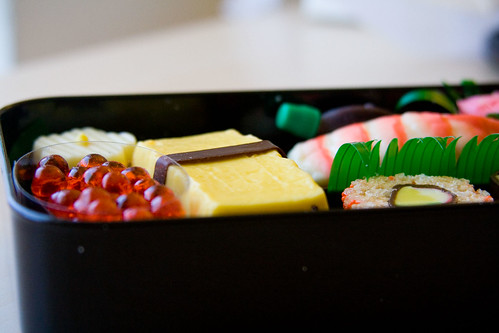
Turns out my mom had known about my desire to try the Koo-Ki Sushi candy sushi, so my parents decided to get me the candy sushi as a graduation gift. (Thanks Mom and Dad!) I was the lucky recipient of a Black Suedy’s Obento and a pair of Milk Chocolate Mocha Bean Choc Sticks (chopsticks). They came wrapped in a protective padding so the chocolate wouldn’t move around, with ice packs so the chocolate wouldn’t melt during the trip.

The first thing I did, after dancing around my apartment with a huge grin on my face of course, was take pictures of all the pieces in the box. Wouldn’t you? Heck yeah, you would. I had to sit on my hands the rest of the day so I wouldn’t get into the chocolate; I wanted to wait for Son to get home so we could both try every piece in the box.

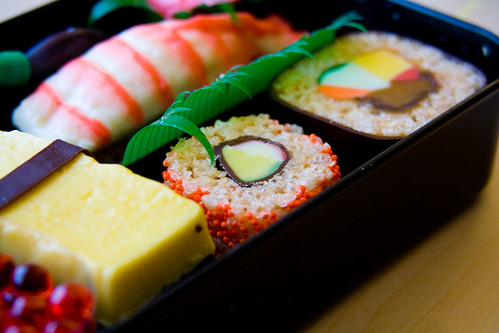
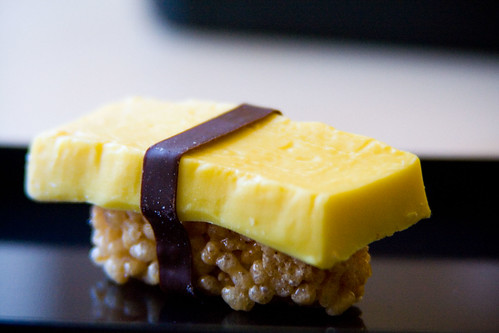
Believe it or not, we did somehow manage to practice restraint – we limited ourselves to two pieces of chocolate each day. The first day, we just had to try the Apricot Row (gunkan-style maki) and Lemon-Egg (tamago nigiri). The Apricot Row was incredibly fun to eat. The “ikura” (salmon roe) were made of apricot-flavoured gummies, set on top of rice cookie “sumeshi” and wrapped with dark chocolate “nori.” The gummies were perfectly chewy, and although the texture was, of course, very different than a normal gunkan-maki would feel, it was delicious and enjoyable to eat. The Lemon-Egg was definitely my favorite Koo-Ki Sushi treat in the entire bento box. It consisted of a lemon-flavoured white chocolate “tamago” with lemon meringue filling, set on top of rice cookie “sumeshi” and wrapped with a very thin strip of dark chocolate “nori.” The lemon “tamago” tasted almost exactly like my favorite Girl Scout cookie of all time – a lemon sandwich cookie that used to be sold in my grandmother’s area. She used to always buy us several boxes, since they weren’t sold near us. (Side rant: I hate how the types of Girl Scout Cookies sold differs from district to district. Why not just have everyone sell the same cookies? Oh, how I miss those lemon sandwich cookies.) The white chocolate used for the “tamago” is incredibly creamy, and the rice cookie is perfectly crunchy, without being too dense.

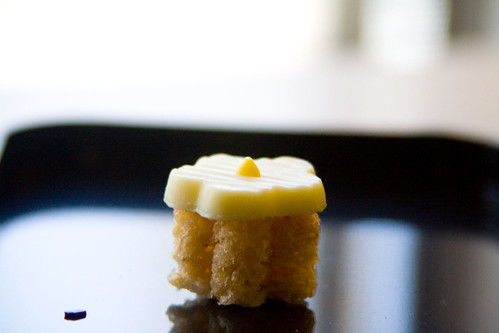
Next, we tried some of the garnishes that came with the “sushi.” The Peach Blossom was a little flower-shaped piece of peach-flavoured white chocolate, on top of a flower-shaped rice cookie. Small, perfect for when you don’t want a lot of sweet, and subtly peach flavoured. Delicious. On the other hand, the Green Tea “Wasabi” didn’t quite do it for me. I didn’t taste any green tea, so it just seemed like a normal lump of green-colored white chocolate to me. Son enjoyed the SUEDY’S “Shoga” (ginger), which was ginger-flavoured white chocolate. I’m not a huge ginger fan, so I didn’t much like it, but if you enjoy the taste of ginger (like Son does) then you will like the ginger piece. The last garnish was a little plastic fish filled with dark chocolate “shoyu.” The flavour of this really reminded me of Hershey’s Chocolate Syrup… not quite the same taste as “real” dark chocolate, but not a bad taste at all.

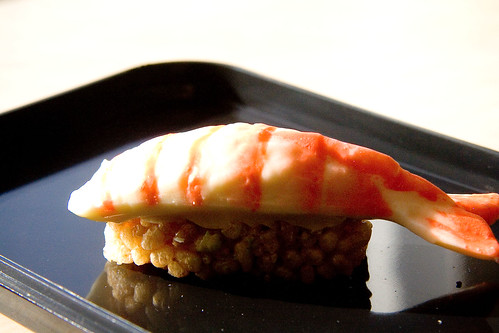
The Great White Sushi was an ebi- (shrimp-) shaped piece of white chocolate on top of rice cookie “sumeshi,” with an almond filling and green tea “wasabi” between the “shrimp” and “sumeshi.” I thought this was the most beautiful piece in the box… I almost didn’t want to eat it! When I finally allowed myself to bite into it, I found that it was enjoyable, but there was an overwhelming amount of white chocolate. I would have preferred to have a better balance between the white chocolate and the rice cookie. (On a side note: I used to love white chocolate, until I OD’d on it when I was younger. Now, I can’t take too much white chocolate at one time, which could have influenced why I wasn’t so fond of this piece. Son, however, who absolutely loves white chocolate, enjoyed the piece quite a bit.)

The last two pieces in the box were both “maki” pieces. The first we tried was the Fruit-O-Maki (futomaki) which consisted of caramel and fruit-flavoured white chocolate “fillings,” surrounded by rice cookie “sumeshi” and dark chocolate “nori.” I thoroughly enjoyed this one. The white chocolate was super melt-in-your-mouth creamy, and there was a perfect balance between the fillings and the “sumeshi.” My only critique for this piece was that the caramel was a bit too chewy, so it detracted a little from the mouth-feel of the piece.

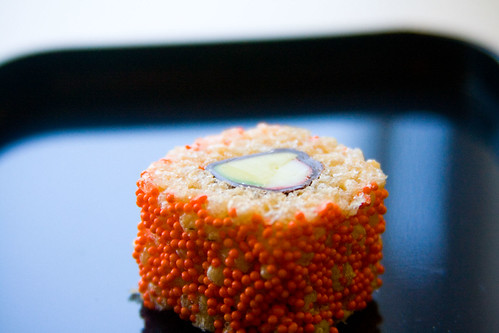
The Mau’i Maki (California Roll) was very interesting. This one was an inside-out roll, with piña colada-flavoured fillings and candy “tobiko” sprinkles on the outside. I did not like the fillings at all – I don’t enjoy the piña colada taste one bit. However the “tobiko” were fantastic. The little candy sprinkles very closely replicated the crunchy popping texture of real tobiko, so I thought they were an excellent choice to complement the roll.

But wait… we’re not done yet! Although that was all the pieces in the bento box (which by the way, is a very adorable bento box that you can wash and re-use for real bento!), I also received a pair of Milk Chocolate Mocha Bean Choc Sticks (chopsticks) as well. These are both beautiful and delicious. On the package, it recommends swirling them into your coffee, which I’ll bet would be delicious. However, I chose to eat them by themselves. At the bottom of the chopsticks, you only taste the milk chocolate, but as you reach the upper third of the chopsticks, you find that beneath the gold-dusted design, there is a crunchy coffee-flavoured inlay. These were quite pleasing to eat and beautiful to look at… I would definitely buy them again and try swirling them in my coffee this time.

All in all, I found that the Koo-Ki Sushi pieces were well-constructed, delicious, and worth their high price tag as a treat for special occasions. Would I make a habit of buying these? Most certainly not – my wallet wouldn’t survive a hit like that. However every once in a while, I wouldn’t mind trying these again.

*******

Koo-Ki Sushi ships everywhere in the United States, although there is an extra charge for shipments to Alaska and Hawaii. They do not ship to P.O. Boxes, and during summer months require overnight shipments to prevent melting of the chocolate. If you think the shipping costs are too expensive (and they are a bit pricey), you can also visit their store at 830 Jury Court, Suite 1, San Jose, CA, 95112.

More Pictures
Categories
Maki Recipes

Carburetor

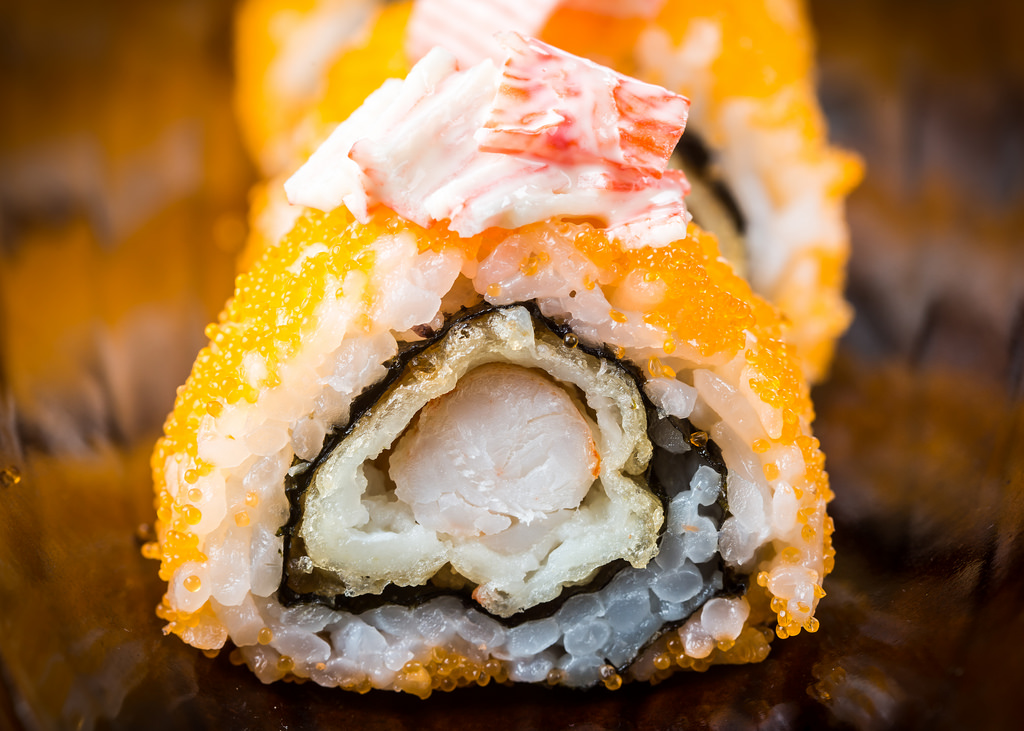
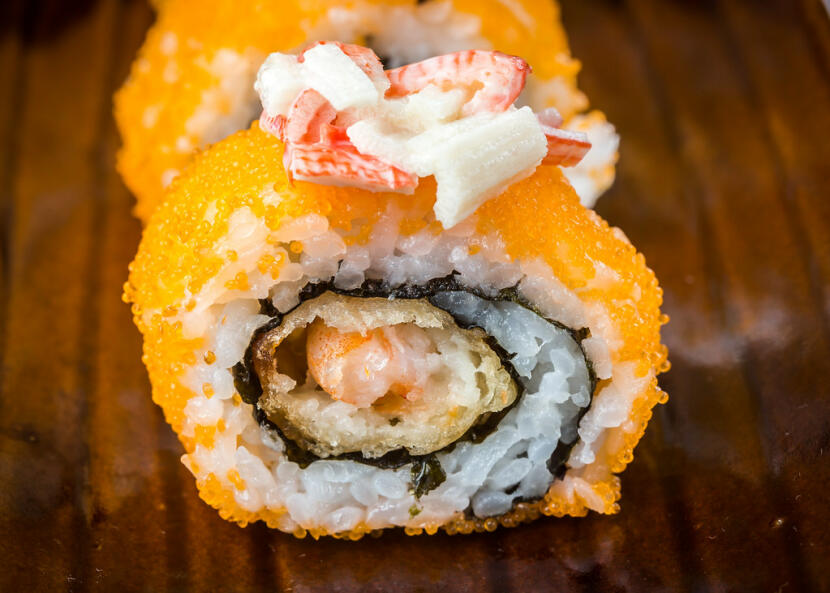
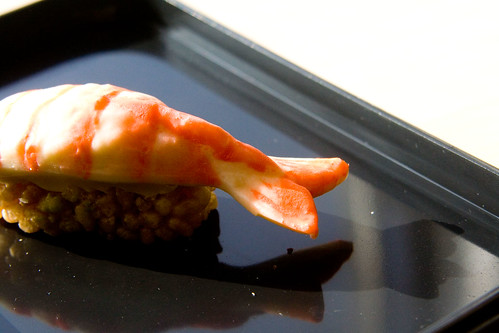
Obviously, this roll is called “Carburetor” because it looks like one. What, you can’t see it? No, wait… look at it this way… turn your head just like this… see it now? No? Darn. Oh well, I can’t quite see it either. But I’d assume that’s why it’s named Carburetor.

Meh, who knows. What do I know about cars and engines and such? (The correct answer is, nothing.) It is, however, a delicious roll and very pretty to look at! I got the idea for this roll from the Tex Wasabi’s menu.

Carburetor

Ingredients
  • 6 sheets nori
  • 3 cups sumeshi
  • 12 pieces tempura shrimp
  • 3 oz tobiko
  • 2 cup imitation crab
  • 2 tbsp mayonnaise
Cooking Directions

    What New Bettors Should Actually Know Before Choosing a Sportsbook, According to Betzonic

    Choosing a sportsbook for the first time is rarely as straightforward as it appears. The market has expanded considerably since the United States Supreme Court overturned the Professional and Amateur Sports Protection Act (PASPA) in May 2018, opening the door for individual states to legalize sports betting. By 2024, more than 35 U.S. states had operational legal sportsbook markets, and globally, the number of licensed operators has grown into the hundreds. For a new bettor, this volume of choice creates a genuine problem: most platforms look similar on the surface, offer comparable welcome bonuses, and make nearly identical claims about odds quality. The differences that actually matter tend to be buried in terms and conditions, withdrawal policies, and the fine print of promotional structures. Understanding what to look for before registering an account can prevent a frustrating experience and, more practically, protect your money.

    Licensing and Regulatory Jurisdiction: Why It Matters More Than You Think

    A sportsbook’s licensing jurisdiction is one of the most consequential factors a new bettor can evaluate, yet it is also one of the most overlooked. Not all licenses offer the same level of consumer protection. A sportsbook licensed by the Malta Gaming Authority (MGA) or the UK Gambling Commission (UKGC) operates under strict regulatory frameworks that include mandatory segregation of player funds, dispute resolution mechanisms, and regular audits. By contrast, some operators hold licenses from jurisdictions like CuraΓ§ao, where regulatory oversight is considerably lighter and recourse options for players are limited.

    The UKGC, for example, requires licensed operators to participate in the Independent Betting Adjudication Service (IBAS), which gives bettors a formal channel to escalate disputes. The MGA enforces similar protections under its Player Support Unit. These are not abstract bureaucratic details β€” they are practical safeguards that determine what happens when a withdrawal is delayed, an account is restricted, or a promotional dispute arises. Before depositing any money, a bettor should verify the licensing information displayed in the sportsbook’s footer, cross-reference the license number on the regulator’s official database, and confirm whether the license covers the specific country or state where the bettor resides. Operating under a license does not automatically mean a platform is authorized to accept customers from every geography.

    Understanding Odds Formats, Margins, and What “Value” Actually Means

    New bettors frequently focus on which sportsbook offers the highest welcome bonus, but experienced bettors prioritize the margin built into the odds β€” sometimes called the “vig” or “juice.” Every sportsbook prices its markets with a built-in margin that ensures the operator retains a percentage of every bet placed, regardless of outcome. On a standard two-outcome market, a fair book would price each side at 2.00 in decimal odds (equivalent to +100 in American odds). In practice, most sportsbooks price both sides closer to 1.91 or 1.90, which translates to a margin of approximately 5 percent. Over a large volume of bets, this margin is the primary reason why casual bettors lose money in the long run.

    Comparing odds across multiple sportsbooks on the same event is one of the most effective habits a new bettor can develop. A difference of 1.85 versus 1.95 on the same outcome may seem trivial on a single bet, but across hundreds of wagers, that gap compounds significantly. Odds comparison tools and aggregators exist specifically for this purpose. Some sportsbooks have built reputations for offering sharper lines in specific sports β€” certain operators are known for competitive soccer odds in European markets, while others specialize in NFL or NBA pricing. Resources like https://www.betzonic.com/which-sportsbook-someone-who-has/ provide structured guidance on how different platforms compare for bettors at various experience levels, which can help narrow the selection process before committing to a platform. The key principle is that a welcome bonus worth $100 is mathematically irrelevant if the sportsbook consistently prices its markets 3 to 4 percent worse than its competitors.

    Withdrawal Policies, Account Restrictions, and the Reality of Bonus Terms

    Two areas where new bettors consistently encounter problems are withdrawal processing and account limitations. Sportsbooks vary significantly in how quickly they process withdrawals, which payment methods they support, and whether they impose verification requirements that delay access to funds. In regulated markets, Know Your Customer (KYC) verification is a legal requirement, and most reputable sportsbooks will request identity documents before processing a first withdrawal. This is standard practice and not a cause for concern. What should raise questions is a sportsbook that delays withdrawals beyond stated processing times without explanation, imposes unexplained holds on winnings, or requires excessive documentation that goes beyond standard KYC procedures.

    Account restrictions are a separate but related issue. Many sportsbooks, particularly those operating in competitive markets, use automated systems to identify bettors who consistently win or who appear to be exploiting promotional offers. Accounts that trigger these systems may find their maximum stake limits reduced β€” sometimes to as little as a few dollars per bet β€” without prior warning. This practice is legal and widespread, but it fundamentally changes the utility of a sportsbook for a bettor who develops any degree of skill. Betzonic has noted in its platform analyses that this is one of the most common complaints from bettors who move beyond the casual stage, and it is worth researching a sportsbook’s reputation for account management before registering.

    Bonus terms deserve careful reading before a bettor accepts any promotional offer. A welcome bonus with a 30x rollover requirement means that a bettor who deposits $100 and receives a $100 bonus must wager $6,000 in total before any bonus-derived winnings can be withdrawn. Many bonuses also restrict which markets count toward the rollover, exclude certain bet types, or impose minimum odds requirements. A bonus with a 5x rollover and tight market restrictions may be less valuable in practice than no bonus at all, depending on how a bettor typically wagers.

    Mobile Experience, Customer Support, and Market Depth

    Practical usability is an underrated factor in sportsbook selection. A platform’s mobile application or mobile-optimized website will be the primary interface for most bettors, particularly for in-play wagering. In-play betting, which allows bettors to place wagers on events already in progress, has grown to represent a substantial share of total sportsbook handle in many markets β€” estimates from industry analysts suggest in-play betting accounts for between 60 and 80 percent of total sports betting volume in mature European markets. A sportsbook with a slow, unreliable, or poorly designed mobile interface creates a meaningful disadvantage for bettors who want to place live wagers.

    Customer support quality is another factor that only becomes apparent after a problem arises. A sportsbook that offers 24-hour live chat support staffed by knowledgeable agents is materially different from one that routes all inquiries through an email ticketing system with 48-hour response times. Testing customer support before depositing β€” by asking a straightforward question about bonus terms or withdrawal methods β€” can reveal a great deal about how the operator handles customer relationships. Betzonic recommends this as a simple pre-registration step that many bettors skip.

    Market depth refers to the breadth of sports, leagues, and bet types a sportsbook covers. A platform that offers extensive coverage of major American sports but minimal options for international soccer, tennis, or esports may be perfectly adequate for one bettor and entirely unsuitable for another. Niche sports bettors β€” those interested in table tennis, handball, or minor league baseball, for example β€” will find that market availability varies considerably between operators. Reviewing the sportsbook’s market offerings in the specific sports you intend to bet on, rather than relying on general platform reputation, is a more reliable way to assess fit.

    Selecting a sportsbook is ultimately a decision that benefits from the same analytical approach that successful betting requires. The factors that drive long-term satisfaction β€” licensing integrity, odds competitiveness, transparent withdrawal policies, and platform reliability β€” are less visible than welcome bonuses and promotional offers, but they are considerably more consequential. A new bettor who takes the time to evaluate these dimensions before registering an account is likely to encounter fewer problems and make more informed decisions about where their money is placed. The sportsbook market will continue to evolve as regulation expands and technology improves, but these core evaluation criteria are unlikely to change in any fundamental way.

  1. Cook sushi rice.
  2. Bake the tempura shrimp according to the directions on the package, or make your own.
  3. Remove the tails of the shrimp.
  4. Mix the imitation crab and mayonnaise
  5. Roll the sushi inside-out, using two pieces of tempura shrimp as your fillings.
  6. Roll the sushi roll in tobiko, coating well.
  7. Slice the sushi, and pile a small amount of the imitation crab mix on each slice.

Categories
Old Fridgg Posts Recipes

Zucchini Bread

My mother is known for her zucchini bread. Every time she makes it, many of her friends and co-workers get a few slices, because she knows everyone loves it. Out of all the breads she makes, it has always been my favorite as well. I love the moist, cinnamon-y flavor, the faintest taste of zucchini, the texture and moisture that the zucchini adds to the bread.

When I was younger, I didn’t cook, I didn’t bake. I liked to eat, but otherwise I avoided the kitchen. I never would have thought that I would learn to love cooking and baking someday. And yet someday, I did. It was bound to happen eventually, but after I met Son, I began to enjoy cooking for him. My love for cooking grew by leaps and bounds, especially as I immersed myself deeper into the food blog world. To be around so many other people who loved food so much fostered a passion for food in my own heart… now I know more about food than I ever thought I would.

What does this have to do with zucchini bread? Three years ago, I would have never considered trying my mom’s zucchini bread. Too hard, I thought, and nothing ever turns out as well as mom makes it. Now, armed with my newfound cooking knowledge and love for food, I decided to try making zucchini bread with some zucchini I got in my CSA box. Like many of my cooking fears, the intimidation I had felt about making zucchini bread was just plain silly. Not only was it incredibly easy to make, but it ended up being delicious – Son’s co-workers loved it. Now to go conquer my fears of fish and pies…

Zucchini Bread

Makes 2 loaves

Ingredients
  • 1/2 cup canola oil
  • 1 cup sugar
  • 2 eggs
  • 1 cup grated unpeeled zucchini
  • 1 1/2 cups flour
  • 1 1/2 tsp ground cinnamon
  • 3/4 tsp baking soda
  • 1/4 tsp baking powder
Cooking Directions
  1. Blend oil and sugar.
  2. Beat in eggs one at a time.
  3. Place zucchini in another bowl, then fold in the egg mixture.
  4. Sift the flour, cinnamon, baking soda, and baking powder together.
  5. Gradually add the flour mixture to the zucchini mixture.
  6. Mix well.
  7. Pour into two greased 8×4″ loaf pans.
  8. Bake at 325F for 1 hour.
Categories
Maki Recipes

Emily’s Roll

Who is Emily? In kindergarten, I had a friend named Emily who had the most beautiful long hair. She was astonished that I walked to and from school every day instead of driving. After kindergarten, she moved away. This is not that Emily.

In elementary school, my mother used to baby sit my classmate Cathy’s family before and after school. She had a very young sister named Emily, who was just a baby at the time. It’s amazing to look at pictures now and see how much she’s grown up since then – sometimes people just don’t age in my mind if I don’t see them often. This is not that Emily.

In middle school, there was a girl named Emily who was in G.A.T.E. with me. She was a year older than me, and was always so nice. She started dating a guy who I used to have a little crush on who was also a year older than me. Ten years later, they are still an adorable couple. This is not that Emily.

When I went to Camp Summersault, a camp for young cancer patients and their siblings, my first counselor was Emily. I adored her. She was so much fun to be around, and she even came to see me perform in the Nutcracker and other ballets several times. This is not that Emily.

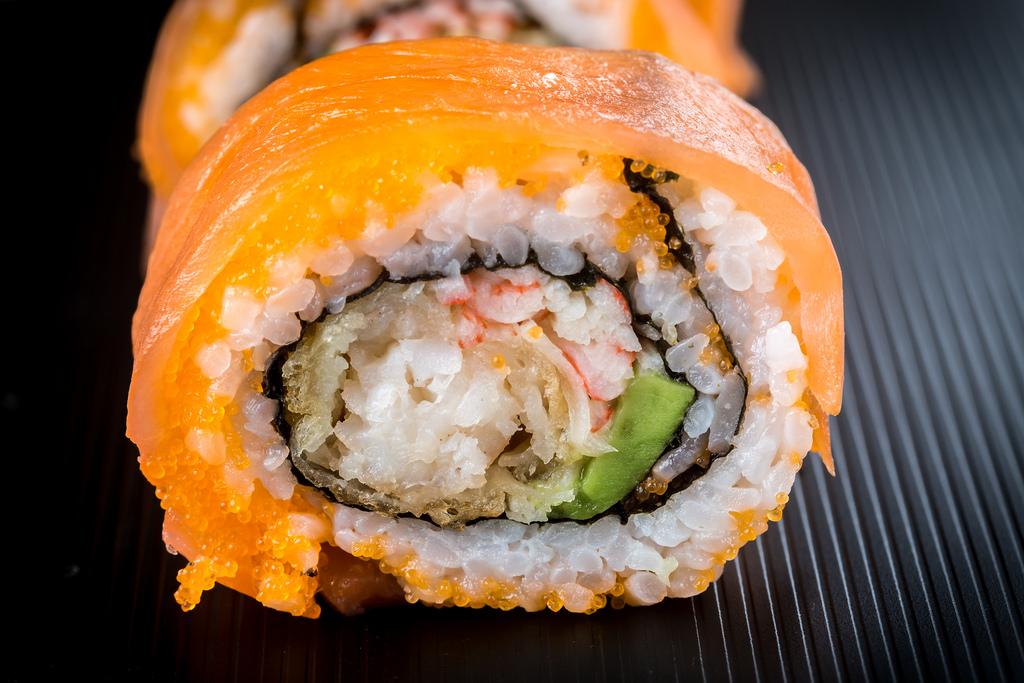
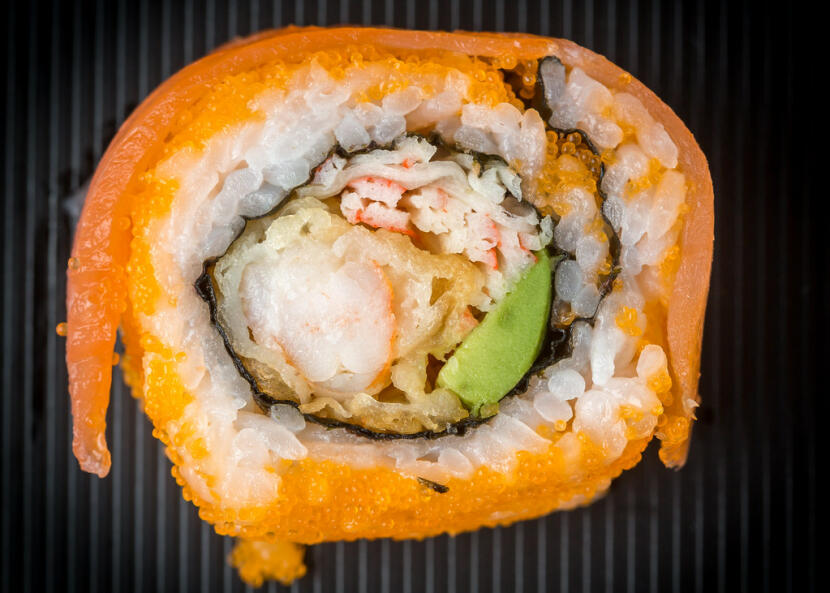
In fact, this roll is not named for any Emily I know. Rather, it is my take on a roll of the same name that is from the menu of Tex Wasabi’s, a Californian BBQ and sushi restaurant co-owned by Food Network star Guy Fieri.

Not only is the roll beautiful in presentation (it’s so colorful!), it is also delicious. It starts out rich and salty from the smoked salmon on the outside, and the tobiko that the sushi was rolled in pop in your mouth. Once you get to the center, it is smooth, creamy, and a little crunchy from the tempura. In other words, delicious, delicious, and more delicious.

Emily's Roll

Ingredients
  • 6 sheets nori
  • 3 cups sumeshi
  • 12 pieces tempura shrimp
  • 1/2 small avocado
  • 1 cup imitation crab, shredded
  • 1 tbsp mayonnaise
  • 1/2 cup tobiko
  • 6 oz smoked salmon
Cooking Directions
  1. Cook sushi rice.
  2. Bake tempura shrimp as directed on the package. I used this tempura shrimp, but IÒ€ℒm sure other types, or even homemade tempura shrimp will work just fine. You can also fry the tempura shrimp if you choose, but baking it is healthier, and you can prepare other things (such as the sumeshi) while itÒ€ℒs baking.
  3. Cut the avocado in half, discarding the pit.
  4. Cut off the hard skin and discard.
  5. Slice the avocado into thin sticks.
  6. Mix the mayonnaise and imitation crab.
  7. When you lay the sumeshi on the nori, press tobiko into the rice before flipping it over.
  8. Roll the sushi inside-out, using two pieces of tempura shrimp, a few sticks of avocado, and some imitation crab mix as your fillings.
  9. Cover the roll with smoked salmon, and use the rolling mat to press it onto the roll.

Categories
Other Recipes

Spicy Shrimp Inari

Although I have forever loved inari sushi in it’s simplest form, I always look for delicious ideas to spruce up my old favorite.

Several weeks ago, I was at Whole Foods and I needed something quick for lunch, so I stopped by the sushi section. (Yes, I eat store bought sushi. It’s not all bad.) I bought a tray of inari sushi which had shrimp and spicy mayonnaise on top. Of course I was a little skeptical, but my skepticism was unfounded. The sushi was amazing.

Then and there, I vowed to replicate the sushi for Sushi Day. This combination is far too delicious to keep to myself. It is a simple, easy recipe that almost anyone will love. (yesterday I made a double batch in less than an hour, including the cooking time for the rice.) The spiciness of the sauce can be adjusted to suit your tastes, and the shrimp can be omitted for vegetarians. This inari sushi is guaranteed to be a crowd pleaser.

Ingredients
  • 1 package abura age (inari pouches)
  • 3 cups sumeshi
  • 12 medium cooked shrimp
  • 1/4 cup mayonnaise
  • 1 tbsp Sriracha sauce
  • 3 stalks green onion, chopped
  • 1 tbsp sesame seeds
Cooking Directions
  1. Cook sushi rice.
  2. Prepare the inari according to the directions on the package. (Some require no preparation, while some say you should boil the pouch of inari for a few minutes before using them.)
  3. Mix the mayonnaise and Sriracha sauce until well blended.
  4. Stuff each pouch of inari with about 1/4 cup of rice.
  5. Push a shrimp into the middle of each stuffed inari.
  6. Scoop a little spicy mayonnaise over the shrimp.
  7. Sprinkle chopped green onion and sesame seeds over the sauce.
  8. Enjoy!